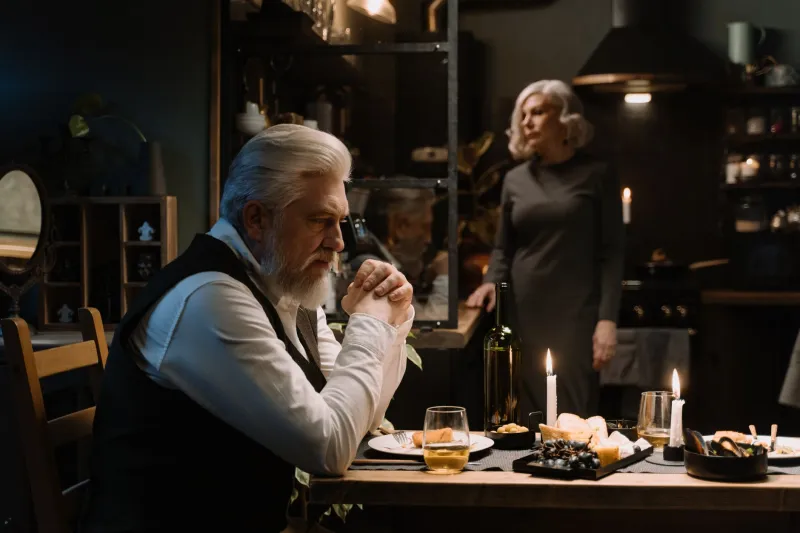
Two Men in One Suit: The Evening Ritual of Shedding the Professional Self

There is a particular moment that many accomplished men recognize instinctively — the precise second when the last conference call ends, the final email is dispatched, and the studied composure that has governed every hour of the working day is no longer required. For some, this moment arrives in a corner office overlooking a city skyline. For others, it comes in the back of a car moving through evening traffic, the day's performance finally behind them. In both cases, something essential begins to shift.
This is not exhaustion. It is something far more deliberate.
The Architecture of the Daytime Self
To understand what transpires after dark, one must first appreciate what the professional persona actually demands. The senior executive, the partner at a white-shoe firm, the founder navigating investor scrutiny — each inhabits a role constructed with considerable care. Every word is measured. Every expression is calibrated. The self that operates in boardrooms and client dinners is a masterwork of controlled presentation, built not through dishonesty but through the rigorous application of professional discipline.
Psychologists who study high-performance individuals have long noted that this sustained self-management carries a genuine cognitive and emotional cost. The effort required to maintain authority, project confidence, and navigate complex interpersonal hierarchies throughout the day is not trivial. By the time the working hours conclude, the most successful men are not simply tired — they are, in a meaningful sense, carrying a version of themselves that no longer fits quite right.
The evening, then, becomes something more than leisure. It becomes a necessary act of recalibration.
Compartmentalization as Sophistication, Not Contradiction
American culture has not always been generous in its interpretation of men who maintain distinct daytime and evening selves. There persists a popular notion that authenticity demands consistency — that the man who presents differently in different contexts is somehow being evasive or duplicitous. This reading is, at best, unsophisticated.
The most self-aware men understand that identity is not singular. The father who becomes playful and unhurried the moment he steps through his front door is not being false at the office; he is being appropriate. The executive who speaks with measured authority to shareholders and with unguarded warmth to close friends is not performing — he is navigating the genuine complexity of a multidimensional life.
What distinguishes the truly accomplished man is not the absence of this duality but the conscious and graceful management of it. He does not allow the professional self to colonize every hour. He creates deliberate space for the other version — the one that laughs without calculation, speaks without agenda, and engages without the weight of institutional expectation.
This is not deception. It is, in its own way, a form of emotional intelligence.
What the Evening Companion Must Understand
It is within this context that the question of evening companionship takes on particular significance. The gentleman who has spent his day performing — negotiating, persuading, leading — does not arrive at an evening engagement seeking more performance. He arrives seeking its opposite.
This is precisely why the quality of a companion's perception matters so enormously. The woman who can read the room before the first word is spoken, who understands that the man across from her is not the same man who closed a deal three hours earlier, and who receives both versions of him with equal grace — she offers something that no credential or conventional social arrangement can replicate.
The companions most valued in elite circles are those who possess a particular kind of emotional fluency. They do not require the gentleman to explain himself. They do not demand that he remain in character, nor do they express surprise when the character quietly dissolves. They meet him where he is, in the particular hour he is living, without imposing expectations drawn from other contexts.
This capacity for non-judgmental reception is, in many respects, rarer and more valuable than beauty or wit alone.
The Specific Appeal of South Asian Relational Sensibility
Among the qualities that have drawn a growing number of American men toward South Asian companionship, this particular form of emotional receptivity occupies a prominent place. There is a tradition within South Asian relational culture — expressed differently across its many regional and social expressions — of receiving the guest, the companion, or the intimate as they actually are, rather than as convention might prefer them to be.
This is not passivity. It is a sophisticated attentiveness that recognizes mood, context, and the unspoken needs of the person present. The companion formed in this sensibility does not require the gentleman to perform for her benefit. She is, in the most precise sense, a safe harbor — a presence within which the professional armor can be set aside without anxiety.
For the American executive who spends his days in environments where every interaction carries consequence, the relief of this kind of company is difficult to overstate.
The Evening as Restoration, Not Escape
It would be a misreading to characterize this nightly transition as escapism. The man who sheds his professional persona in the evening is not running from his life — he is sustaining it. The ability to return, night after night, to a version of oneself that is unencumbered by role and obligation is precisely what allows the professional self to function at the highest level when morning arrives.
Athletes understand recovery as integral to performance. The most effective executives are beginning to apply the same logic to their interior lives. The evening, deliberately designed and thoughtfully inhabited, is not a departure from the serious business of a serious life. It is, in fact, its foundation.
Companionship that honors this understanding — that treats the evening hours as genuinely distinct from the professional day, and that meets the gentleman in his unguarded state with intelligence and discretion — is not a luxury in the trivial sense. It is a resource. A recalibration. A form of care that the most self-aware men have come to regard as essential rather than incidental.
The Quiet Recognition
There is a particular look that passes between a gentleman and a companion who truly understands this dynamic — a quiet acknowledgment that what is happening in the room is not performance, not transaction, but something closer to genuine human encounter. It requires no explanation and invites no analysis. It simply is.
For the man who has spent his day being many things to many people, this moment of being received as simply himself — unranked, unscheduled, and unhurried — is among the most valuable experiences the evening can offer. Finding a companion capable of providing it is, increasingly, the work of the discerning gentleman.